
Blog · AI & Technology
AI Is Running Hot: The Liquid-Cooling Boom and the Domains Built for It

The AI answers, images and code generated in the cloud all end up as heat inside a data center. In 2026 that heat has become one of the industry's main engineering problems, and one of its fastest-growing businesses. Air cooling is no longer enough for the newest AI racks: a single Nvidia Vera Rubin rack is reported to draw 190 to 230 kW, and the IEA expects data center electricity use to more than double to around 945 TWh by 2030. Liquid has to come right up to the chip.
This article sets out the numbers behind the liquid-cooling boom, explains the key technologies in plain words, and introduces six domain names that use the industry's own vocabulary: cold plate, CDU and rack heat.
Figures last checked: October 2026.
1. The money: about $700 billion of capex in one year
The four largest US cloud companies (Amazon, Alphabet, Microsoft and Meta) are spending at a record pace. Analysts who track their guidance put their combined 2026 capital expenditure at around $700 billion (Futurum), against roughly $410 billion in 2025 (Yield Theory). Much of it goes into AI data centers: buildings, power, chips and the equipment that keeps those chips from overheating.
Electricity tells the same story. The International Energy Agency estimates that data centers used about 415 TWh in 2024 and projects this will more than double to around 945 TWh by 2030, with AI as the main driver. Almost all of that power ends up as heat that has to be removed.
2. Why air is no longer enough
A traditional server rack draws a few kilowatts and can be cooled with fans and chilled air. AI racks are a different class of machine. Nvidia's GB300 NVL72 rack is reported at about 140 kW, and the new Vera Rubin NVL72 at roughly 190 to 230 kW per rack (Introl). Roadmaps for 2027 already discuss racks of around 600 kW.
At those densities, air simply cannot carry the heat away fast enough. The new racks are fully liquid-cooled, and server makers now ship them with complete cooling stacks. Supermicro, for example, delivers Vera Rubin racks together with in-row coolant distribution units rated at 1.8 MW each.
3. The technology in plain words
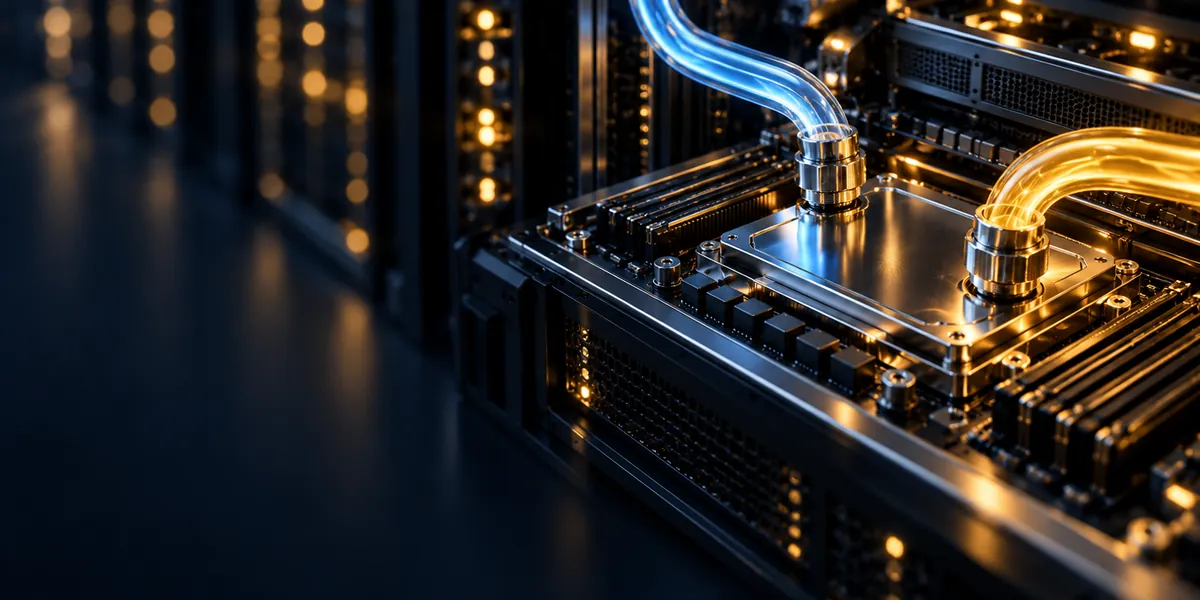
- Cold plate: a metal plate with tiny internal channels, mounted directly on a GPU or CPU. Liquid flows through it and carries the heat away. This is called direct-to-chip cooling, and it is the largest segment of the market: Mordor Intelligence puts its share at about 43% in 2025.
- CDU (coolant distribution unit): the pump-and-heat-exchanger unit that feeds the cold plates, controls pressure, temperature and flow, and separates the clean loop inside the servers from the facility's water. CDUs can sit inside a rack or in a row next to the racks.
- Rack heat and heat reuse: once heat is in water at 45 to 65 °C, it can be used again, for example in district heating networks, instead of being thrown away.
4. A market forecast to grow several times over
Estimates differ by scope, but the major research firms we reviewed all forecast steep growth. MarketsandMarkets projects the data center liquid cooling market to grow from $4.07 billion in 2026 to $27.65 billion by 2033, a compound annual growth rate of 31.5%. Other firms put 2026 between $4 billion and $7 billion, with growth forecasts of roughly 16% to 32% a year.
5. Billion-dollar deals
Large industrial groups are buying their way in, and paying high prices:
- Ecolab and CoolIT Systems: $4.75 billion. In March 2026 Ecolab agreed to buy CoolIT, one of the best-known cold-plate and CDU makers, from KKR, at about 24 times CoolIT's expected 2027 EBITDA (Business Wire).
- Schneider Electric and Motivair: $850 million for 75%. Announced in October 2024, giving Schneider a full liquid-cooling line including CDUs and cold plates (DatacenterDynamics).
- Vertiv's string of acquisitions. In 2026 Vertiv bought Strategic Thermal Labs, a cold-plate engineering firm, and in September agreed to acquire King Environmental Services, a specialist in fluid management for liquid-cooled data centers (Vertiv, SEC filing).
Alongside the giants, dozens of start-ups are launching cold plates, CDUs, leak detection, coolants and monitoring software. Each of them needs a name the industry understands at first glance.
The names
These six domains use the terms engineers and buyers already search for, so a data center operator understands them without explanation.
ColdPlateAI.com
Cold plate: a metal plate with internal channels that carries liquid coolant directly over a hot chip to remove heat.
AIColdPlate.com
Direct-to-chip cooling: liquid cooling where coolant flows through cold plates mounted on processors.
CDUCooling.com
CDU (coolant distribution unit): equipment that pumps, filters and controls the liquid coolant flowing to servers.
SmartCDU.com
Smart CDU: a coolant distribution unit with sensors and software that monitor flow, temperature and leaks.
RackCDU.com
In-rack CDU: a coolant distribution unit installed inside a server rack instead of on the data center floor.
RackHeat.com
Rack heat: the heat produced by the servers in one data center rack, which must be removed or reused.
Who these names are for
- Cooling start-ups launching cold plates, CDUs, coolants or leak detection.
- Established HVAC and industrial groups opening a dedicated AI data center division.
- Server makers and integrators that want a separate brand for their liquid-cooled racks.
- Software companies building thermal monitoring and control for high-density racks.
- Media, events and research covering data center cooling.
Buy one, or the whole set
Together the six names cover the full cooling chain, from the plate on the chip to the CDU that feeds it and the heat that leaves the rack. A company that owns all six holds the core vocabulary of its market. Each name can be bought on its own with Buy Now, or you can make one offer for the whole set using the button below. Direct deals close through Escrow.com, and you will get a personal reply within 24 hours.
Sources
- Futurum: AI Capex 2026, the $690B infrastructure sprint
- Yield Theory: Hyperscaler capex 2026 guidance by company
- International Energy Agency: Energy and AI
- Introl: Nvidia Vera Rubin platform infrastructure
- The Data Center Engineer: Supermicro ships Vera Rubin NVL72 racks with liquid cooling stack
- Mordor Intelligence: Data center liquid cooling market
- MarketsandMarkets: Data center liquid cooling market 2026–2033
- Business Wire: Ecolab to acquire CoolIT Systems
- DatacenterDynamics: Schneider Electric acquires majority stake in Motivair
- Cooling Post: Vertiv buys liquid-cooling technology business
- Vertiv (SEC filing): agreement to acquire King Environmental Services